
Category Archives: news

Gov. Kaisch & Lt. Gov. Taylor On CSI Ohio: The Common Sense Initiative

In March, Gov. John R. Kasich won his second major legislative victory. This was a major step toward cutting government red tape and tearing down barriers to job creation by signing into law Senate Bill 2, legislation establishing CSI Ohio: the Common Sense Initiative.

S.B. 2 (Hughes) essentially codifies Kasich’s first executive order signed on January 10, placing Lt. Gov. Mary Taylor in charge of CSI Ohio and developing a process for holding state agencies accountable for promoting flexibility, balance, transparency and consistency as rules and regulations impacting businesses are developed or renewed.

“Seeking the right balance of regulations that makes Ohio businesses competitive while protecting the health and safety of our citizens is our goal and this bill certainly helps us accomplish that,” Kasich said. “Ultimately this is a huge victory for job creators who want to locate, grow, expand and create jobs right here in Ohio.”

S.B. 2 received broad bipartisan support following a 32-to-1 vote in the Ohio Senate on February 23 and an 81-to-14 vote in the Ohio House of Representatives on Wednesday, March 2.

Highlights of Senate Bill 2 include:

Business Impact Analysis: CSI Ohio will require agencies to adequately address the purpose of each proposed rule or regulation and the adverse impact to business.

JCARR: Allows the Joint Committee on Agency Rule Review to invalidate proposed rules when agencies fail to justify a regulatory benefit.

Customer Service: CSI Ohio will require state agencies to develop customer service standards and integrate them into the job descriptions and performance evaluations of employees.

In a previous interview, Taylor responding to the newly passed bill, said:

“This is common sense and it is encouraging to see the legislature support CSI Ohio and our process of cutting through the red tape and eliminating burdensome, costly and duplicative rules and regulations,” Taylor said. “This will help us revive Ohio’s economy and improve our business community’s ability to put their job-creating ideas into action.”

On Saturday May 14, the Business Journal Daily also interviewed Lt. Gov. Taylor about CSI and its reception by Ohio business. A video of the interview can be watched by clicking here.
Economy, Washington Are Hindering Small Business Growth, Survey Finds

The Small Business Outlook—a nationwide survey of more than 900 small business owners—found that 84% of small businesses think the United States is headed in the wrong direction, and 83% think the national economy is on the wrong track. Some 87% of the respondents think Congress is standing in the way of economic growth and progress, while 75% feel the president is standing in the way.

“What we’re hearing is that small business wants Washington to get out of the way, and they want more certainty,” said Bill Miller, senior vice president of Political Affairs and Federation Relations at the Chamber. “Uncertainty is a significant impediment, and small businesses are reluctant to get into the game until they know what the rules are.”

Read the rest of this article in the Free Enterprise Magazine.

SBE Councils “Business Tax Index” Ranks State Tax Systems

The Small Business & Entrepreneurship Council (SBE Council) published its “Business Tax Index 2011: Best to Worst State Tax Systems for Entrepreneurship and Small Business.” The index ranks the 50 states and District of Columbia according to the costs of their tax systems for entrepreneurship and small business.

Raymond J. Keating, chief economist for SBE Council and author of the report, said: “Higher taxes have an impact on a state’s competitiveness. There is a reason why low tax states are better able to attract investment, and ‘Business Tax Index 2011’ helps to shed light on the tax burdens that are affecting the decisions of individuals and businesses. In many states, elected officials continue to propose tax increases – and actually raise them – in order to fund out-of-control government spending. High levels of spending translate into increased tax burdens on the entrepreneurs and investors who drive economic growth and job creation.”

SBE Council’s “Business Tax Index 2011” pulls together 18 different tax measures, and combines those into one tax score that allows the 50 states and District of Columbia to be compared. Among the taxes included are income, capital gains, property, death/inheritance, unemployment, and various consumption-based taxes, including state gas and diesel levies.

Keating added: “State and local taxes affect the decisions made by entrepreneurs, investors, businesses and individuals. Several states in recent years have hiked taxes in response to excessive government spending, and declining revenues in a down economy. In high-tax states, elected officials have refused to cut spending or slow its growth. The implications for entrepreneurship, small businesses, competitiveness, investment and employment are significant.”

According to the “Business Tax Index 2011,” the 15 best tax systems are: 1) South Dakota, 2) Texas, 3) Nevada, 4) Wyoming, 5) Washington, 6) Florida, 7) Alabama, 8)Alaska, 9) Ohio, 10) Colorado, 11) South Carolina, 12) Mississippi, 13) Oklahoma, 14) Virginia, and 15) Missouri.

The 15 worst state tax systems are: 37) Illinois, 38) North Carolina, 39) Nebraska, 40) Connecticut, 41) Oregon, 42) Rhode Island, 43) Hawaii, 44) Vermont, 45) California, 46) Maine, 47) Iowa, 48) New York, 49) New Jersey, 50) Minnesota, and 51) District of Columbia.

SBE Council President & CEO Karen Kerrigan added: “The path is pretty simple for elected officials that want to attract investment, encourage small business growth and create jobs. Keep taxes low, and get spending under control. In several states – particularly those that are making headlines such as Ohio and Wisconsin – the Governors are working to do just that, and these states will reap the benefits of their sound approach. A competitive tax system will help small businesses grow, and allow each state’s economy to thrive.”

Higher Energy Prices Dominate Legislative Activity

With higher gas prices undermining small business growth and potentially the economic recovery, various approaches addressing the issue are being pursued in the U.S. House and Senate.

Senate Majority Leader Harry Reid (D-Nev.) Senate Majority Leader Reid will open floor debate this week on the Democrats’ bill to raise taxes on the largest oil/gas companies. As the Congressional Research Service has reported, hiking energy taxes will only translate into higher prices and less supply. SBE Council adds “fewer jobs” to the list of ills. So, raising energy taxes will increase business costs even more as SBE Council President & CEO Karen Kerrigan noted at a May 9 media briefing at the National Press Club.

“Proposals that hike energy taxes are unthinkable given the fragile state of the economy. Small business owners continue to struggle with weak sales while their business costs tick higher. Raising taxes on energy will exacerbate uncertainty, and the real challenge that many small businesses face in regard to their ability to compete in and survive the tough economy. Higher energy taxes mean higher costs for small businesses, and it’s irrational for Washington to inflict more pain on our nation’s struggling entrepreneurs,” said Kerrigan. SBE Council has urged the Senate to reject these tax hike proposals and focus on solutions that increase supply and will help make energy costs more affordable.

“Washington needs to pursue and enact policies that promote business confidence, investment, certainty and growth for small businesses – indeed for all sectors and industries,” said Kerrigan. “Policies that encourage energy exploration and development, while promoting investment, will lead to a more reliable supply and lower energy prices. Raising energy taxes is the wrong approach.”

Meanwhile, over in the House, SBE Council is supporting two pieces of legislation that will be voted on this week. SBE Council sent letters to all members of the House communicating support for H.R. 1229, “Putting the Gulf Back to Work Act” and H.R. 1231, “Reversing President Obama’s Offshore Moratorium Act.” Both of these bills will help move energy policy in a positive direction by encouraging domestic exploration and development, which will bring more certainty to energy supply and foster affordability. For the thousands of small business owners and millions of employees whose livelihoods are tied to a vibrant energy sector, these two bills are also critically important.

The latest SBE Council Energy & Entrepreneurs analysis reviews why some politicians are pursuing vindictive policies against the energy sector in light of recent profit reports. “As sure as the sun rises in the east and sets in the west, no doubt existed as to what the reaction would be in certain political circles to recent reports on oil industry profits,” SBE Council chief economist Ray Keating writes. He sorts out the politics, the policies and the economics in the piece “Bonus Resource: Why Gas Prices are Rising – Let’s Investigate,” by SBE Council’s Keating.

Boeing vs. the NLRB: A Naked Power Grab by Radical Pro-Unionists

The National Labor Relations Board (NLRB) contends that President Obama’s chief of staff, Bill Daley, threatened and made coercive statements against Boeing employees.

You haven’t heard about these charges?

Daley was on Boeing’s board of directors when the company unanimously decided to open up a second assembly line for the 787 Dreamliner in Charleston, S.C. The NLRB argues this illegally violated the rights of Boeing’s unionized employees. The complaint against Boeing thus implicates Daley in any supposed wrongdoing — although the mainstream media has avoided mentioning this.

Of course, anyone familiar with the National Labor Relations Act (NLRA) will tell you that the NLRB’s charges have no merit. Daley would have never got past White House vetting otherwise.

In short, Boeing made a legal business decision that unions opposed, and the NLRB is using this as a pretext to unlawfully expand its power.

Read the rest of this article at Pajamas Media.

A Short Response to the Innovation Ohio Report

“Ohio Teachers and Collective Bargaining: An Analysis”

By Matt A. Mayer, President of Buckeye Institute

First, we welcome Innovation Ohio to the public policy debate. Innovation Ohio joins the existing pack of progressive think tanks-Policy Matters Ohio, ProgressOhio, the Center for Community Solutions, Economic Policy Institute, and the Center for Working Class Studies-advocating for the same set of policies for Ohio. We will continue to do our best to keep up with these groups.

Next, we are perplexed that Innovation Ohio (and the Ohio Education Association), given the report?s findings that teachers make more outside of collective bargaining, does not support Senate Bill 5. Specifically, the report found that “the BLS data reveal that the more states erode teachers? rights to collectively bargain, the more it likely will lead, on average, to higher salary increases.” Perhaps they believe teachers would rather have more process than higher pay.

Finally, the report found that “Ohio?s kindergarten, elementary, middle school and high school teachers saw their salaries, on average, drop 3.8% between 2008 and 2009.” This finding, based upon a limited national survey, conflicts with the more comprehensive school district data from the Ohio Department of Education.1 The ODE data shows that, instead of pay cuts, teachers across Ohio saw their median pay increase from 2008 ($49,951.40) to 2009 ($50,557.50) by $606.00, or 1.2 percent. Ohio teachers? median pay rose even higher from 2009 to 2010 ($52,001.00), as the median pay jumped by $1,443.50, or 2.9 percent.

As the financial projections of the 613 school districts show, by 2015, 91 percent of Ohio?s school districts will reach severe deficits. Compensation packages will swallow 96 percent of projected revenues. With local taxes already high, homeowners across Ohio likely will not support increased operational tax levies. We look forward to seeing our friends on the left and the OEA provide solutions to this mounting crisis. For a district-by-district financial review, please see the easy-to-read charts at buckeyeinstitute.org/reports/school-districts.

1 Ohio Department of Education, District Data – Teacher Information 2008-2010, Interactive Local

Report Card Home (accessed on February 28, 2011) available at lrc.ode.state.oh.us/Downloads.asp.

Hello world!

Welcome to WordPress. This is your first post. Edit or delete it, then start blogging!

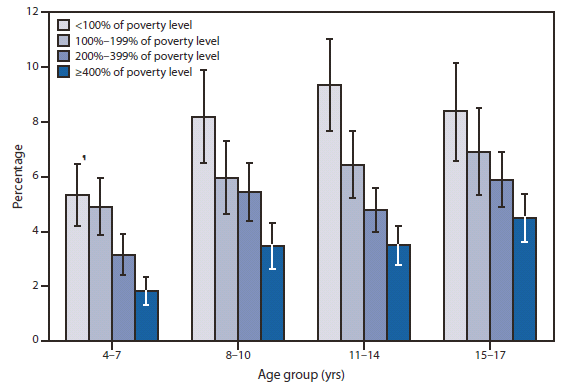
Poverty the Cause of Serious Emotional and Behavioral Problems Among Children?

During 2004-2009, approximately 5.1% of all U.S. children aged 4-17 years were reported by parents as having serious emotional or behavioral difficulties. Across all age groups, poor children (i.e., those living in families with incomes <100% of the poverty level) more often were reported to have serious emotional or behavioral difficulties compared with the most affluent children (i.e., those living in families with incomes ?400% of the poverty level). For example, among children aged 11–14 years, approximately 9.3% of poor children were reported by parents to have serious difficulties, compared with 3.5% of the most affluent children. (CDC, May 6, 2011)

Supporting the statistics above is research published in the American Journal of Preventative Medicine. The multi-author report titled “Effectiveness of Universal School-Based Programs to Prevent Violent and Aggressive Behavior” stated the following:

“Over the last 25 years, youths aged 10 to 17 years, who constitute less than 12% of the population, have been involved as offenders in approximately 25% of serious violent victimizations.[3] Homicide and suicide, respectively, are the fourth and fifth leading causes of death among children aged 5 to 14 years, and the second and third leading causes of death among people aged 15 to 24 years.[4]

“Risk factors for youth violence include low socioeconomic status (SES), poor parental supervision, harsh and erratic discipline, and delinquent peers.[5] Delinquent youths commonly have other problems as well,[6] including drug abuse, difficulties at school, and mental health problems (as indicated by being in the top 10% of the distribution of externalizing and internalizing symptoms in the Child Behavior Checklist[7]). These youths are threats not only for the direct harm they may cause, but also because they may play roles in the socialization of other potential delinquents.[8]”

Yet, the Columbine High School massacre was perpetrated by youth from upper-middle class backgrounds. So were many other youth who killed their peers. The same was true of those Arab-Muslims who perpetrated the 9-11 attack. Growing up in a violent drug culture will obviously influence a child’s emotions and behavior and school programs may help prevent some children from succumbing to it. However, it is parents, relatives and close family friends who have the strongest influence.

If society would reform the political economy for the common good, most poor families would no longer be poor. Emotional and/or behavioral problems resulting from financially induced stress of many parents would wane. The emotional and behavioral problems of many children would subside as well. Even though economic status is not really the answer to those problems, alleviating stress related issues is at least part of the solution.

Liberals seem to see welfare socialism as the needed reform, and conservatives see less government bureaucracy that comes with welfare and more free market initiatives as the appropriate reform. It is doubtful that either have the right solution.

Planned Parenthood Ignores Fetal Pain; Goes After Personhood Amendments

Planned Parenthood and the ACLU have filed an appeal to the State Supreme Court against Mississippi’s Personhood Amendment, Amendment 26, despite numerous rulings against them.

In July of 2010, Planned Parenthood and the ACLU filed suit to disallow Mississippi voters from voting on the Mississippi Personhood Amendment. In October, the lawsuit was rejected. The Court decision read “Initiative Measure No. 26 has received more than the required amount of signatures to be placed on the ballot and the Constitution recognizes the right of citizens to amend their Constitution.”

Now Planned Parenthood and the ACLU have appealed to the State Supreme Court, a decision made especially conspicuous by Planned Parenthood’s recent refusal to challenge various “Fetal Pain” bills. According to the Kansas Department of Health and Environment, one abortion in 2010 would have been prevented by the Fetal Pain bill. By contrast, Mississippi’s Personhood Amendment 26 would make all abortion illegal by recognizing the personhood rights, first and foremost the constitutional right to life of all children, born and preborn.

This is not the first time that the ACLU and Planned Parenthood have tried to stop Personhood USA – numerous lawsuits have been filed, albeit largely unsuccessfully, in an attempt to stop Personhood USA and its state affiliates.

“Of course we expect Planned Parenthood and the ACLU to continue their unholy alliance in attacking personhood bills and amendments,” explained Keith Mason, cofounder of Personhood USA. “They are terrified that abortion will be made illegal. Planned Parenthood, with the help of the ACLU, is fighting for their ‘right’ to kill children for profit.”

Personhood Amendment 26 states, “The term ‘person’ or ‘persons’ shall include every human being from the moment of fertilization, cloning or the functional equivalent thereof.”

“Personhood Amendments and bills nationwide merely recognize that all human beings are people,” continued Mason. “Recognizing that all human beings have rights is a sentiment the ACLU should be fighting FOR, not against. Instead, the ACLU has teamed up with Planned Parenthood to ensure that Planned Parenthood’s deep pockets are protected. It is outrageous that the billion dollar abortion industry’s bottom line is more important to them than over one million innocent human lives taken every year by abortion.”

Personhood USA’s amendments and bills recognize that every human being is a person, and every person has a right to life. Personhood amendments and bills protect every child, no matter their size or age.

Visit the Personhood USA website to learn more about its mission and Petition to the Ohio Legislature.

Ohio Case Roe v. Planned Parenthood is Resolved — What is There to Hide?

Life Legal Defense Foundation (LLDF) is pleased to announce that the Ohio case, Roe v. Planned Parenthood, Case No. A0502691, Hamilton County Court of Common Pleas, has been “resolved and dismissed,” according to a statement by the attorney for the plaintiffs, Brian Hurley (Crabbe, Brown & James LLP).

Resolution of the case comes just months after a major blow to Planned Parenthood’s (PP) defense on the applicability of Ohio’s informed consent statute. Judge Jody Luebbers ruled that the doctor for PP of Southwest Ohio breached her legal duty by not having an “informed consent” meeting with Jane Roe 24 hours in advance of her abortion, and by failing to obtain written informed consent from Jane and at least one of her parents since Jane was a minor at the time.

In addition to the lack of informed consent, the plaintiffs sought compensatory and punitive damages against PP for failure to comply with their statutory duty to inform Jane Roe’s parents of her intended abortion. Jane, at age 14, had been impregnated by her 21-year-old soccer coach, also the man who brought her in for the abortion. Instead of notifying Jane’s parents, as required by Ohio law, PP phoned the sexual predator. PP’s failure to notify Roe’s parents and to gain informed consent resulted in Jane not only undergoing the abortion, but also in the continued cover-up of the sexual abuse, demonstrating a disturbing trend in PP clinics: disregard for the health and wellbeing of women and children.

“Resolution of this case must have been an act of desperation on the part of PP,” states Dana Cody, LLDF’s President and Executive Director. “They went, in a matter of months, from litigating every inch of their defense to a sudden willingness to resolve the matter. I would speculate that had PP gone to trial there would have been too much exposure of how they do business. After all, they are currently experiencing public outrage over their apparent willingness to cover up the sexual exploitation of children. What more might they have to hide?”

LLDF commends Brian Hurley for his tremendous work on Roe. His diligence and perseverance continues in another Ohio case, Fairbanks v. Planned Parenthood, case no. A0901484, Hamilton County, Ohio, where Mr. Hurley is representing Denise Fairbanks. The claims include PP’s failure to report statutory rape by Ms. Fairbanks’ father when at age 16 she was taken to PP for an abortion. The complaint states that although she informed PP staff of the abuse, they did not report to local law enforcement, and for more than a year she continued to suffer abuse that PP could have prevented by simply complying with the law.

Life Legal Defense Foundation was established in 1989, and is a nonprofit public interest law firm composed of attorneys and other concerned citizens, committed to the sanctity of human life. LLDF provided support for Jane Roe’s case and continues to provide assistance in Ms. Fairbanks case.

Source: Christian Newswire, April 27, 2011.