Category Archives: economy

NY Times Cuts More Sections

By Don Irvine

With ad revenue and circulation shrinking The New York Times announced that they are chopping The City section and including the material in a Sunday metro report to save millions of dollars.

From the New York Observer Bill Keller made it official moments ago:

The City section, the regionals and the Escapes section will be eliminated as stand-alone sections in The Times.

Instead, they’ll just use material that may have appeared in those sections in a Sunday metro report.

“We will consolidate Sunday Metro area coverage in a new Sunday feature section, which will be a showcase for news and features from the city and beyond. (Metro area breaking news will be incorporated into the A-book.),” he wrote in a memo this morning. “The new section will include zoned pages for Connecticut, New Jersey, Westchester and Long Island. Joe Sexton and Jodi Rudoren have taken on the project of developing a prototype, and we hope to launch the new section on May 24, replacing the City section and regional weeklies.”

I think Keller and company have forgotten that on the front page of the Times is the slogan “All the News That’s Fit to Print.” Maybe they should change that to “All the News That We Can Afford to Print.”

Source: Boycott The New York Times, April 17, 2009

Ohio House Approves Gov. Strickland’s Politically Correct Outcome-Based Education Plan

Last week, the Ohio House of Representatives finalized its revisions of Gov. Strickland’s evidence-based school funding reform.

According to a recent AP report,

Strickland proposed a dramatic overhaul of Ohio’s school funding formula that would boost the state’s share of the cost and reduce what taxpayers are expected to contribute to their local schools. His proposed “evidence-based” education system would require schools to use programs based on research findings and would set standards for students, teachers and districts. Districts would be audited annually and could be shut down for repeated failure to meet academic and operating standards.

The evidence-based system is the same as the outcome-based system that was defeat the last time it was proposed. This version coincides somewhat with “No Child Left Behind” requirements. The main issue with the proposed system is its inclusion of politically-correct attitude, feeling and behavioral outcomes. This may also be called mind-control or brainwashing for good secularist citizenship. If 80% of Ohioans are religious, an additional 80% of Ohio children will be made good practical atheists. That is something evolutionists like Richard Dawkins, Strickland, and followers would gleefully approve.

Despite the changes made by the House, Rep. Stephen Dyer, chairman of the budget subcommittee on primary and secondary schools, said the essence of Strickland’s “evidence-based” is still intact.

The following are some of the more significant changes mentioned in the AP report.

  • Extending implementation from eight years to 10 years.
  • Increasing base teacher salary from $45,000 to $49,914.
  • Capping growth in state aid at 1.9 percent a year, compared with the 15 percent and 16 percent Strickland had proposed.
  • Giving the state six years, rather than two, to pick up a larger share of local school costs.
  • Allowing districts more flexibility in how soon they start new initiatives such as lowering student-teacher ratios, lengthening the school year, and implementing all-day kindergarten.

Raising the pay scale of teachers is a good thing, but don’t let it be a distraction from the real issue. As noted above, the state plans to control local education. If the Left achieves this goal, the plan of world socialists (the Left) will be complete. That means Capitol Hill politicians will ultimately control all schooling, and in the end the United Nations will dictate the content and structure of American schooling.

If you think the above is preposterous, then consider this: the federal government now owns American financial businesses, they recent passed universal health care (medial socialism), our welfare economy is based on Marxist socialism, and American education is now within their reach. The goal of NAFTA is to create a North American Union according to United Nations plans. Many of the federal leaders approve of the global currency discussed at the last G20 summit.

As Professor Economics Charlotte Twight explained in her book Dependent On D.C., the federal government has every intention to bring Ohio education under its total control. Gov. Strickland is a member of the Capitol Hill club seeking to achieve the goals of the Left.

Xenia 3.5 Mill Operating Levy Renewal Coming Soon

It appears that Xenia management and our Council representatives got the message during the February 2009 election. By a large majority, Xenia voters defeated an effort to pass a very large 5.0 mill operating levy replacement levy increase. The annual revenue it would have generated ($1.86 million) was way beyond any perceivable need.

Instead of seeking the next highest amount possible (3.5 mill replacement), the Council has decided to take the “What Works” approach. During the March 26, 2009 meeting, management seem to have decided that Council should initiate the process that will put the 3.5 Mill Operating Levy Renewal on the August 4, 2009 ballot. That they did.

Council could have saved taxpayer $18,000 had they sought for a renewal in the first place. Because the cost of placing a levy up for a vote is the above amount, the renewal will now cost taxpayers $36,000.

By the way, Councilman Dale Louderback was the only member who has refused to accept anything other than a renewal. Why was he the only dissenting voice against the February levy? Apparently, his conscience would not permit him to ask voters for such a huge increase during our nation’s near depression-like economic crisis. He is fully behind the no-new-taxes operating levy renewal.

One last observation; I can only imagine the distaste that observant Jews by that ancient priestly name, Levy or Levi, must have towards our politically and sometimes greed motivated government levies.

Economic Stimulus Funding Xenia Capital Improvements (but Not Jobs)

The American Recovery and Reinvestment Act (Economic Stimulus) was approved by the House and Senate on February 13, 2009. According to the Recovery.gov web site, the goal of the Economic Stimulus is to jumpstart the economy, create or save jobs, and put a down payment on addressing long-neglected challenges so our country can thrive in the 21st century.

How does the economic stimulus flow to communities like Xenia?

The money flows similar to the way federal money is disbursed, which is through the State of Ohio, then to local communities. The Governor’s Office has set up a website whereby communities and other entities can submit projects. Xenia, like many other cities submitted a wide range of projects that included street reconstruction, street extension, water line construction, park development and redevelopment, downtown streetscape, pedestrian and bicycle improvement and extension, retention of police manpower and high speed internet connection. The projects that were submitted to the Governor’s Office are then reviewed by the different State Departments. Projects that are considered “shovel ready” get priority funding.

Projects that have received funding in Xenia.

The Ohio Department of Transportation was the first Department to review and take action on project proposal. These projects were reviewed through the Miami Valley Regional Planning Commission (MVRPC). This agency made recommendations on which projects to submit. The transportation and street enhancement related projects that were approved in Xenia include:

1. Innovation Way Road Extension – $2,267,551.00. This is located in a new industrial complex between Union Road and S.R. 380. The first phase of Innovation Way is currently being constructed. Economic Stimulus dollars will fund $2,267,551.00 of the $3,209,681 project cost.

2. East Main Street Streetscape Improvement between Whiteman Street and Collier Street – $209,348.00. This project involves replacement of trees, installation of ornamental lighting, replacement of sidewalks, curbs, installation of crosswalks and accessible ramps and provision of streetscape hardware like benches, trash receptacles, planters and banners.

3. Bicycle and Pedestrian Crossing Improvement from Xenia Station Hub to the Ohio-Erie Trail – $51,123.00. This involves improving the crosswalk with proper pavement marking, re-orienting of existing accessible ramps, widening of existing sidewalks on the east side of South Detroit Street between Hill Street and Washington Street and replacement of the catch basin with a storm manhole.

I could think of better ways to pay for those improvements to our city than to give Capitol Hill more reason to think in terms of ownership.

Source: Xenia Development Corner Newsletter, March 2009.

Wondering what is being built next to Applebee’s Restuarant?

If you guessed it was another restaurant, you get a big fat A for Accurate-guessing.

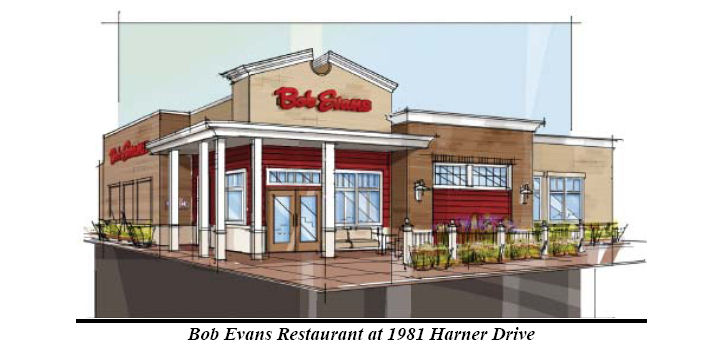
According to the latest Xenia Development Corner Newsletter, Bob Evans Restaurant has started constructing their second restaurant at 1981 Harner Drive. This particular building design is being unveiled in Xenia and will be the first of many they hope to build throughout this region. The new restaurant is going to be over 5,000 square feet, roughly the same size as the existing Bob Evans Restaurant on 400 West Main Street.

According to Bob Evans Restaurant Officials, the two restaurants will initially be maintained and operated for a while. Eventually, the one on West Main Street will be closed.

What is the City of Xenia Home Repair Program?

Now that spring has sprung in Xenia. Homeowners are beginning to think about repairing the home. The current dilemma is money. Not that money isn’t always an issue, but many pocket books are experiencing the effects of the economic recession. The most affected are likely to be the low- and moderate income homeowners. Those who are may find some financial assistance in Xenia’s Home Repair Program.

The Home Repair Program is a grant program that helps low-moderate income homeowners to repair housing conditions that pose an immediate threat to the health and safety of the occupants, or pose an ongoing threat to the structural integrity of the home.

The program offers up to $8,000 for single item repairs such as roofs, gutters and downspouts, windows and doors, electrical, plumbing heating, insulation, foundations, bathroom upgrades, water heaters, handicapped accessibility repairs and more.

To qualify for a Home Repair grant, you must meet the following criteria:

1. You must be the owner of the home (not a renter) in the City of Xenia.

2. You must live in the home as your permanent residence.

3. Your home must be in need of health, safety or emergency repairs not      exceeding $8,000.

4. You must be income eligibility requirements.

Financial eligibility is based on maximum income. For example, the maximum income limit for a household of 1 is $33,700, for a household of 2 it is $38,500, for a household of 3 it is $43,300, the maximum income limit for a household of 4 is $48,100, and so on.

To find out more about the program, visit the Xenia Home Repair Program website or call 937-562-5007.

Real problems undermining our children’s economic future

By John Mitchel

A while back the Beavercreek (Ohio) mayor was investigated for an alleged conflict of interest regarding a service contract with a private developer. Before the 2008 election, the Ohio Elections Commission investigated a candidate for Greene County recorder for removing an opponent’s yard signs. Recently a former Xenia Assistant Prosecutor appeared in court for allegedly scamming a client during an estate settlement. I suppose covering allegations on ethically challenged elected and appointed officials are warranted, but there are much more serious infractions being ignored by public officials and the press.

Take for example other shenanigans going on in Greene County. For nearly two years this reporter has been investigating the 2003 BRAC Initiative Agreement between Greene County Commissioners and the Dayton Development Coalition. There’s a mountain of evidence that points to bid-rigging, illegal campaign contributions and money laundering, a violation of the Racketeering Influenced Corrupt Organizations (RICO) Act. Just follow the $1.9 million that starts with Greene County tax dollars; then through no-bid contracts, goes to the Dayton Development Coalition; then to Greentree Group, a Beavercreek government support contractor and then to Washington lobbying firm, PMA, which is under investigation for illegally bundling campaign contributions to John Murtha, Dave Hobson, Steve Austria and over a hundred other members in the U.S. Congress. From there it turns up as campaign donations from associates and family of these private corporations to Hobson, Austria and other elected officials. Finally, the money is spent on questionable expenditures, including spending by “Dave Hobson for Congress” on pest control, maid service and lawn-care, not to mention over $90,000 in other undisclosed expenditures. (Source: www.opensecrets.org)

If both public officials and the press take the time to address petty squabbles among city councilmen, intra-party bickering involving a two-dollar yard sign and relatively low-dollar abuses by former public officials, you’d think they would be all over a $1.9 million “earmarks-for-campaign-cash” scheme perpetrated in part by former and current U.S. Congressmen. These are the real problem that undermine our children’s economic future and it’s time the media shine a bright light on their abuses.

Dayton Tea Party @ 6-8PM Courthouse Square

The Dayton Tea Party has received over 5,000 RSVPs for their April 15 Income Tax Day Rally at Courthouse Square from 6 to 8 p.m. in downtown Dayton (corner of Third & Main).

The Dayton Tea Party Rally seeks to protest runaway spending at all government levels. The Rally will feature dynamic speakers from the Miami Valley. Modeled after the Boston Tea Party tax protest of 1773, the April 15 rally will pressure Congress to repeal the federal stimulus plan and draw attention for needed fiscal restraint, support for the free market and small business, and respect for the Constitution.
“We are all geared up for the rally,” said Perry Reynolds, co-founder of the Dayton Tea Party. “Our supporters are excited and pumped for April 15.”

“We are seeing support everywhere throughout the Miami Valley from all political spectrums,” said Rob Scott, co-founder of the Dayton Tea Party. “This event is not about political labels but standing up for what the Tea Partiers believe in.”

The Dayton Tea Party is a grassroots and nonpartisan group opposed to wasteful government spending. The Tea Party is made up of students, homemakers, working people, professionals who are Democrats, Independents, Republicans, and Libertarians.

For directions, a list of speakers, or other information, go to their website at www.daytonohioteaparty.com. For directions or a list of speakers, For questions, contact info@daytonohioteaparty.com.

Another attempt by Ohio legislators to legalize casino-style gambling

Apparently, Ohio lawmakers don’t get it. Ohioans are not in favor of padding the pockets of businesses or politicians with family-destroying addition money. For many gamblers, gambling is pathology. This pathology results in the ruin of personal finances, family welfare, and individuals lives. Yet, Ohio politicians seem blind to anything except money, which is evident in the following Dayton Daily News article.

State Reps. Todd Book, D-McDermott, and Louis Blessing, R-Cincinnati, said on Tuesday, April 7, that they’re drafting legislation based largely on an Ohio Racing Commission plan to put 14,000 slot machines at Ohio’s seven racetracks without a vote of the people.

They’re gathering cosponsors and hope to introduce the bill next week, Book and Blessing said.

Separately, Philip Craig, executive director of the Ohio Licensed Beverage Association, said he is gathering legislative support for a plan to permit slot machines at bars and restaurants, also without the vote of the people.

The effort has support from bar owners such as David Grusenmeyer in the Dayton area, who said business at his three bars is the worst he’s seen in 24 years. He owns two bars in Huber Heights and one in Fairborn.

Work on both proposals comes with the Ohio Ballot Board scheduled to meet on Monday, April 13, to consider a petition from backers of a proposal for casinos in Cleveland, Columbus, Cincinnati and Toledo. The board must give its OK before supporters can begin to gather the 402,275 signatures needed to put the proposal on the Nov. 3 ballot.

As you can see, the proposed bill is intended to benefit only a few businesses. The reason Ohio needs slot machine gambling at racetracks and in bars is to bailout them out of their financial recession.

Even worse is the repeated use of this golden cash cow to save education from its supposed financial woes justification is getting nauseating.

The state’s weak economy combined with money woes at the tracks make it the right time to discuss expanding the Ohio Lottery to include slot machines at the tracks, said Book. The proposal will call for 51 percent of gross revenue to go to education, said Blessing.

If the economy were so bad that people aren’t spending enough of their unemployment or stimulus checks, how would gambling solve this cash flow problem? Maybe, the best thing for voters handing onto to their dollars is for such business to cease to exist. Taxpayers should refuse to allow politicians to use their tax dollars to prop up poorly managed businesses or those whose products and services are no longer in great demand. The larger they are the louder the sound of good riddance should be heard. Such shouting might even stimulate voters to put those politicians who supported this bill and others like it on unemployment, in my humble opinion.

Source: Dayton Daily News, April 8, 2009

Glory be! Tax Freedom Day arrives on April 13

Tax Freedom Day® will arrive on April 13 this year, the 103rd day of 2009. That means Americans will work about three and a half months of the year, from January 1 to April 13, before they have earned enough money to pay this year’s tax obligations at the federal, state and local levels. Tax Freedom Day falls a full two weeks earlier in 2009 than it did in 2007. In fact, not since 1967 has Tax Freedom Day come earlier than this year’s April 13 date.

This shift has been driven by two factors: the recession has reduced tax collections even faster than it has reduced income; and the stimulus package, a.k.a. HR 1, the American Recovery and Reinvestment Act of 2009, includes large temporary tax cuts for 2009 and 2010. Nevertheless, in 2009, Americans will pay more in taxes than they will spend on food, clothing and housing combined.

While tax revenues are falling, government expenditures are expected to explode in 2009, also driven in significant part by HR 1. Tax Freedom Day, like almost all tax burden measures, ignores the current year’s deficits. If the projected deficit for 2009 were counted as a tax, Tax Freedom Day would arrive on May 29 instead of April 13-the latest date ever for this deficit-inclusive measure.