Category Archives: politics

Poll: Americans Want National Debt Paid Down, Not Increased Through More Spending

According to this McClatchy-Marist Poll, nearly six in ten American adults — 59% — want the federal government to make the reduction of the debt its priority even if the economy is slow to recover.

Capitol Hill politicians should get the hint that Americans are against raising the debt ceiling. They want a balanced budget. They need to find a way to reduce the debt by half in order leave with their means.

Every empire, the Roman Empire included, defaulted on its debt. Why should America be any different? Imperialists always spend more than a working public can afford, which is the reason why so many Americans went backruptcy or default on their loans during the great recession. The American government reflects its people. Well, the current politicians reflect about a third.

About one-third — 33% — want the government to stimulate the weak economy even if it costs more money.

“For the public, it’s all about the debt,” says Dr. Lee M. Miringoff, Director of The Marist College Institute for Public Opinion. ”For Washington, the devil is in the details.”

Looking at party, 79% of Republicans want the debt to be paid down while 15% think stimulating the economy should be the priority. There is less of a consensus among Democrats. Half — 50% — believe the government should focus on stimulating the economy while 45% say the national debt should top the government’s “to do” list. More than six in ten independents — 61% — think the priority should be the reduction of the debt even if the economy rebounds slowly. This compares with 32% who say the stimulation of the economy should be the main issue even if it costs more money.

The McClatchy-Marist Poll reported Americans are still pessimistic about the economy and for good reason: Three in four believe the U.S. is still in recession.

A majority of Americans — 53% — say that, when thinking about the U.S. economy, the worst is yet to come. However, 42% believe the worst is behind us. Six percent are unsure. When McClatchy-Marist last reported this question in April, 57% thought there was more bad economic news to come, 39% said better economic days were ahead, and 4% were unsure.

And, 75% of residents nationally still think the country is in a recession. This compares with one in five — 20% — who say the nation has come out of the recession. Five percent are unsure. In April, similar proportions held these views. At that time, 71% reported the recession was not over, 25% said it was, and 4% were unsure.

To read more, go to the Marist Poll.

Follow-Up News About Iranian Pastor Nadarkhani

According to more recent news sources, Pastor Nadarkhani’s death sentence was annulled on Sunday. The Iranian Supreme Court sent the case back to the pastor’s home town and asked the pastor to repent, meaning to renounce his Christian faith.

Christian and human right organizations believe Pastor Nadarkhani is still in danger of losing his life. Even his lawyer was arrested for working with the Centre for the Defence of Human Rights. (See articles by the Christian Post and the Christian Telegraph, and on FarsiNet).

Pastor Nadarkhani’s letter issued in October 2010. Click here to read.

How to help Pator Nadarkhani, visit the website Prisoner Alert.

Citing President’s Christian & Muslim Heritage, Rutherford Institute Calls on Obama to Intervene in Execution of Christian Pastor in Iran

John W. Whitehead, president of The Rutherford Institute, has called on President Obama to intervene in the impending execution of Youcef Nadarkhani, a Christian pastor in Iran who was convicted of apostasy. In a letter to President Obama, which was copied to the Iranian ambassador, members of Congress and other key dignitaries, Whitehead urged the president to demand that Iran abide by its obligations under the Universal Declaration of Human Rights and its own Constitution, which provides that “no one may be molested or taken to task simply for holding a certain belief.”

The Rutherford Institute’s letter on behalf of Youcef Nadarkhani is available at www.rutherford.org.

“If citizens in Iran cannot depend upon the protections of the most basic human rights provided in their own Constitution, then we must offer them the solace of a watching world that is willing to intervene politically,” stated John W. Whitehead, president of The Rutherford Institute.

“Surely we cannot stand silently by as this man of faith is martyred. Youcef’s imminent execution presents the United States with an opportunity, and, I submit, a duty, as a beacon of liberty, to interpose its influence and authority on behalf of such inalienable human rights as are inherently beyond legitimate government sanction.”

According to reports by the Assyrian International News Agency, Christian pastor Youcef Nadarkhani was convicted of apostasy after protesting the government’s decision to teach Christian schoolchildren–including Youcef’s own 8- and 6-year-old sons–about Islam. Over the course of the past two years Youcef has spent in prison, he has allegedly suffered various forms of inhumane and irregular punishment, including a denial of access to his attorney, the arrest of his wife, threats to place his two sons in the custody of Muslim families, and the administration of drugs in an attempt to force him to recant his religious faith. Youcef’s sentence to be executed by hanging was recently upheld by the Iranian Supreme Court. It is reported that the death sentence may be carried out at any given time without advance notice. Youcef will likely be ordered once again to recant his faith, and if he refuses, he will be executed immediately.

Constitutional attorney and author John W. Whitehead is founder and president of The Rutherford Institute. He can be contacted at johnw@rutherford.org. Information about the Institute is available at www.rutherford.org.

Common Sense Transcends Circumstance

By Cameron Smith

This Fourth of July, as we celebrate our nation’s independence with flags and sparklers, families and friends will gather together, and many will fail to reflect on the importance of this celebration.

When the Revolutionary War began, many of the colonists opposed independence from Great Britain. In a very real sense, the Founding Fathers were considered radicals by their fellow countrymen. Without changing the hearts and minds of the colonists, these revolutionaries risked losing everything and vanishing into the history books largely unnoticed.

During the early part of 1776, Thomas Paine’s pamphlet, Common Sense, lit the spark that would ignite the push for independence and ultimately change the colonial culture. Common Sense aggressively challenged the control of the British Government and the merits of the monarchy. Paine’s plain language and direct approach were met with immediate success. About 120,000 copies were sold in the first three months and 500,000 in the first year and Paine donated the royalties to support the Continental Army. Arguably, without Paine’s “treasonous” pamphlet, American independence might well have been delayed or extinguished. John Adams claimed, “[w]ithout the pen of the author of ‘Common Sense’,” the sword of Washington would have been raised in vain.”

But is Common Sense still a relevant factor in modern American government? At the inception of independence, there was virtually no federal government. Today, with a multitrillion dollar budget, more than 14 trillion dollars in debt, and more than 160,000 thousand pages of federal regulations, the government Americans live under is radically different that that experienced 235 years ago. Fortunately, Paine’s work is more than just a pleasant vestige of America’s historical past.

Common Sense resonated with the everyday man in his language, appealed to his values and gave him the goal of having a voice in his government. As the colonists recognized their increasing interest in independence, the willingness to fight for it grew as well. The colonial elites who sought to negotiate with Britain were quickly outpaced by those quite literally saying “liberty or death.”

Thanks to the electoral structures created by Paine and his peers, Americans need not revolt. But the percentage of Americans who did not even cast their vote in the most publicized Presidential election in recent history is shocking — forty-three percent of the current American population failed to vote in the 2008 presidential election. Moreover, less than 38 percent of the voting age population voted in the 2010 midterm election. Individual liberty and freedom from government without representation seems to be taken increasingly for granted and their erosion has gone progressively unnoticed. Americans witnessing this trend should readily relate to Paine’s calls for meaningful participation in government.

Unfortunately, the freedoms secured in the Revolution are no less fragile today than they were when first achieved. Executive agencies treat the Constitution as an antiquated suggestion while the judicial branch, through a radical reading of the Commerce Clause, is on the precipice of destroying the remaining vestiges of federalism and limited federal power. All this takes place while Congress piles mounds of generational debt upon our nation through a lack of fiscal discipline and political courage. These are not mere concerns of the politically active but viable threats to individual liberty and our founding notions of restrained government.

Common sense transcends circumstance and the passage of time. As our nation again celebrates its birth, Americans must consider their ability to participate in their own governance. These rights were created and protected by the blood of patriots and the sacrifice of their families. While reasonable minds may differ about specific policies, each generation must ask whether the current practices of government comport with their notions of common sense. Where the government fails to meet the expectations of the governed, each citizen owes those who have come before and those who will come after the duty to participate in the American democracy.

In justifying the need for the Revolutionary War, Thomas Jefferson stated that “[w]e cannot endure the infamy and guilt of resigning succeeding generations to that wretchedness which inevitably awaits them if we basely entail hereditary bondage on them.” Whether that bondage comes in the form of an oppressive government, a legacy of debt or simply through a failure to teach the next generation about the price of liberty, this current generation must not ignore the real threats facing our nation.   (Emphasis by the editor)

Cameron Smith is General Counsel for the Alabama Policy Institute, a non-partisan, non-profit research and education organization dedicated to the preservation of free markets, limited government and strong families, which are indispensable to a prosperous society.

Our Nation’s Birthday, Moment to Celebrate Democracy

By Congressman Sherrod Brown

Independence Day is an opportunity to commemorate the founding of our nation, as well as the promise that life, liberty, and the pursuit of happiness are rights – not privileges.

Every American should have access to the tools needed to build a meaningful life.

Elementary students in Elyria deserve to learn from the latest text books. Grandparents in Grandview should never be forced to choose between buying medicine or a meal. And firefighters in Fairfield have earned the right to fight a fire with reliable, modern protective gear.

In a democracy, national priorities should reflect the needs of all citizens – not just the privileged.

Two hundred and thirty-five years after British subjects declared themselves United States citizens, Americans must continue the journey toward becoming a more perfect Union.

We’ve made tremendous strides in guaranteeing fundamental rights to education, health, and safety. Ohio established free, public education in 1825. Today – with the support of some $400 million in “Race to the Top Funds” – Ohio schools are working to build on proven models of success and to empower students with the science, technology, engineering, and mathematics skills needed to embark on 21st century careers.

In the late 19th and early 20th centuries, public health resources in Ohio were consumed by the fight against tuberculosis and the cholera epidemic. With the passage of the Affordable Care Act, children can now remain on their parents’ health insurance until they reach 26 years of age. Seniors can receive annual wellness visits that will not only keep them healthier, but will also reduce costs by helping avoid illnesses. And we’re investing in preventive care and reforming our delivery system so that medical practitioners are rewarded for the outcome of their patients, not how many tests are ordered.

Public safety has also improved. In 1853, Cincinnati established the first fully-paid, professional fire department in the United States. It would take another decade for the first self-contained breathing apparatus to be invented. Today, professional firefighters can breathe safely while communicating with one another in a black, smoke-filled building.

Progress in our educational institutions, public health, and safety could not have happened without industrious Americans pushing for improvements. Time is not enough to usher in lasting change. It also takes human effort.

And, it is only with continued advocacy that we will be able to move closer to achieving a more perfect Union.

Life, liberty, and the pursuit of happiness are easier to secure when everyone who wants to work has a job.

That is why America must reinvest in our most important industries. In Ohio, where agriculture remains our largest sector, we must continue to support small farmers and planters who deserve to carry on their family legacy of providing the food that feeds and fuels America.

Manufacturing is another critical industry for America – and our state. Ohio is home to more than 21,000 manufacturing companies. Three of the top twenty manufacturing cities in the U.S. are located in the Buckeye State. By establishing a National Manufacturing Policy – employed by so many industrialized countries – we can ensure that this vital industry remains strong in the 21st century and continues to lead our economic recovery.

We can ensure that Ohioans are equipped with the skills needed to fill good-paying, high-tech jobs. Legislation – like the Strengthening Employment Clusters to Organize Regional Success (SECTORS) Act, which I recently introduced ­– can create partnerships among community colleges, labor, workforce boards, and emerging industries to rejuvenate American manufacturing.

Yes, there are challenges to be met. But, as Americans, we also have a wealth of opportunities to do great things.

Since our founding, Ohio has been a state of vanguard achievements. Innovative Ohioans built the first successful airplane, invented the modern traffic signal, completed the first orbit of Earth by an American, and eight Ohioans have led as President of the United States.

Today’s schoolchildren, senior citizens, public servants, and all Americans have a role to play in creating the country our founders envisioned.

With common-sense legislation and concrete leadership, we can continue to honor our founders and achieve an even better future.

Thomas Jefferson, the American Mind and the Cosmic System

By John W. Whitehead

On May 26, 1776, John Adams, who represented Massachusetts at the Second Continental Congress, wrote exultantly to his friend James Warren that “every post and every day rolls in upon us independence like a torrent.” Adams had reason for rejoicing, for this was what he and others had hoped and worked for almost since the Congress had convened in May of the previous year. It helped, to be sure, that George III had proclaimed the colonies in rebellion and this encouraged the Americans to take him at his word. Later, George Washington proceeded to drive General Howe out of Boston. This demonstrated that Americans need not stand on the defensive, but could vindicate themselves in military strategy quite as well as in political.

However exciting to some, America was going through the difficult process of being born. In any event, the stage of history was being set. On June 7, 1776, Richard Henry Lee of Virginia introduced three resolutions calling for independence, foreign alliances, and confederation. Some wanted unity and voted to postpone the final vote for three weeks. This allowed time for debate and for the hesitant and fainthearted to come over or step out. Meantime, Congress appointed a committee to prepare “a Declaration of Independence.” This committee consisted of Benjamin Franklin, John Adams, Roger Sherman, Robert Livingston, and Thomas Jefferson.

Jefferson had come to the Continental Congress the previous year, bringing with him a reputation for literature, science, and a talent for composition. His writings, said John Adams, “were remarkable for their peculiar felicity of expression.” In part because of his rhetorical gifts, in part because he already had a reputation of working quickly, in part because it was thought that Virginia, as the oldest, the largest, and the most deeply committed of the states, should take the lead, the committee unanimously turned to Jefferson to prepare a draft declaration.

We know a great deal about the composition of that draft. Jefferson wrote it standing at his desk (still preserved) in the second-floor parlor of a young German bricklayer named Graff, and he completed it in two weeks. We have his word for it that he “turned neither to book nor pamphlet” and that all the authority of the Declaration “rests on the harmonizing sentiments of the day, whether expressed in conversation, in letters, printed essays, or in the elementary books of public right, as Aristotle, Cicero, Locke, Sidney, etc.” We can accept Jefferson’s statement made fifty years later that the object of the Declaration was to be “an appeal to the tribunal of the world”–that “decent respect to the opinions of Mankind” invoked in the Declaration itself. However, in Jefferson’s words (as he wrote to James Madison in 1823), it certainly was “not to find out new principles, or new arguments, never before thought of; not merely to say things which had never been said before; but to place before mankind the common sense of the subject, in terms so plain and firm as to command their assent, and to justify ourselves in the independent stand we are compelled to take. Neither aiming at originality of principle or sentiment, nor yet copied from any particular and previous writing, it was intended to be an expression of the American mind, and to give to that expression the proper tone and spirit called for by the occasion.”

The Declaration of Independence, then, was an expression of the American mind that was prevalent in the colonies of that time. As Jefferson stated, the Declaration contained no new ideas, nor was there any originality in it on his part. He merely articulated what people of that day were thinking.

The basic elements of the American mind are set forth in the opening paragraphs of the Declaration of Independence. The Declaration opens by stating:

When in the Course of human events, it becomes necessary for one people to dissolve the political bands, which have connected them with another, and to assume among the powers of the earth, the separate and equal station to which the Laws of Nature and of Nature’s God entitle them, a decent respect to the opinions of mankind requires that they should declare the causes which impel them to the separation.

The opening paragraph of the Declaration states that the colonists are impelled or required to separate from Great Britain for certain reasons:

We hold these truths to be self-evident, that all men are created equal, that they are endowed by their Creator with certain unalienable Rights, that among these are Life, Liberty and the pursuit of Happiness.–That to secure these rights, Governments are instituted among Men, deriving their just powers from the consent of the governed,–That whenever any Form of Government becomes destructive of these ends, it is the Right of the People to alter or to abolish it, and to institute new Government, laying its foundation on such principles and organizing its powers in such form, as to them shall seem most likely to effect their Safety and Happiness. Prudence, indeed, will dictate that Governments long established should not be changed for light and transient causes; and accordingly all experience hath shewn, that mankind are more disposed to suffer, while evils are sufferable, than to right themselves by abolishing the forms to which they are accustomed. But when a long train of abuses and usurpations, pursuing invariably the same Object evinces a design to reduce them under absolute Despotism, it is their right, it is their duty, to throw off such Government, and to provide new Guards for their future security.

This preamble sums up with lucidity, logic, and eloquence the philosophy which presided over the argument for the American Revolution, the creation of a new political system, and the vindication of the rights of man–all in less than two hundred words. Here we find expressed what is universal rather than parochial, what is permanent rather than transient, in the American Revolution. Where most of the body of the Declaration is retrospective, the preamble is prospective. In the years to come, it would be translated into the basic institutions of the American republic.

Consider the opening words of the Declaration: “When, in the Course of human events…” That places it, and the Revolution, at once in the appropriate setting, against the backdrop of not merely American or British but universal history. That connects it with the experience of people everywhere–not only at a moment in history, but in every era. This concept of the place of American history is underlined by successive phrases of the opening sentence. It points to a future of hope and optimism.

Thus, the new nation is to assume its place “among the powers of the earth.” It is not the laws of the British empire, or even of history, but of “Nature and of Nature’s God” which entitled Americans to an equal station. Moreover, it is “a decent respect to the opinions of mankind” that requires this justification. No other political document of the eighteenth century proclaims so broad a purpose. No political document of our own day associates the United States so boldly with universal history in the cosmic system.

The American mind of the colonial period did not acknowledge a different order of truth, one for the lofty realms of mathematics, another for the more earthbound regions, and still another for society, politics, and the economy. While clearly discernible in the natural world, the cause of “Nature and of Nature’s God” applied equally to the world of politics and to the law. Benjamin Franklin, as a young man, said:

How exact and regular is everything in the natural World! How wisely in every part contriv’d. We cannot here find the least Defect. Those who have studied the mere animal and vegetable Creation demonstrate that nothing can be more harmonious and beautiful! All the heavenly bodies, the Stars and Planets, are regulated with the utmost Wisdom! And can we suppose less care to be taken in the Order of the Moral than in the natural System?

From such a God-ordered system, certain truths are self-evident. To Jefferson, these self-evident truths formed a total reality. He listed seven of them:

1. That all men are created equal;
2. That human beings are endowed by their Creator with “unalienable” rights;
3. That these rights include life, liberty, and the pursuit of happiness;
4. That it is to secure these rights that government is instituted among men;
5. That governments are instituted to derive their powers from the consent of the governed;
6. That when a form of government becomes destructive of these ends, it becomes illegitimate and a citizenry may alter or abolish it; and,
7. That people have the right, then, to institute new governments designed to effect their safety and happiness.
Continue reading

Ohio Legislature Passes Pro-Life State Budget

(COLUMBUS) – Today the Ohio Legislature passed a state budget which includes multiple pro-life amendments. The state budget, House Bill 153, now advances to pro-life Governor John Kasich. Among other things, the state budget contains Ohio Right to Life amendments that will protect taxpayer dollars from paying for abortion. The first amendment bans abortions from being performed in public hospitals. The second amendment prohibits abortion coverage in insurance plans of local public employees.

“These two pro-life amendments will ensure that Ohio taxpayer dollars are not funding abortion,” said Mike Gonidakis, executive director of Ohio Right to Life. “It is crystal clear that a vast majority of Ohioans oppose all forms of taxpayer funding of abortion.”

Additional pro-life amendments were also included. One measure requires the Ohio Department of Health to apply for federal abstinence education grants to reduce the number of unplanned pregnancies. The final pro-life amendment preserves the right of student groups to use and benefit from school funds and facilities, therefore protecting the rights of pro-life groups on college campuses.

House Bill 153 will be signed into law on June 30th by pro-life Governor John Kasich, who Ohio Right to Life fully expects to support each of these life-saving measures. Ohio Right to Life expresses its sincere gratitude to Senate President Tom Niehaus (R-New Richmond), Senator Shannon Jones (R-Springboro), Senator Peggy Lehner (R-Kettering), Senator Scott Oelslager (R-North Canton), along with Speaker of the House Bill Batchelder (R-Medina) and Representative Jim Buchy (R-Greenville) for their pro-life leadership in the General Assembly.

Poll: More than Six in Ten Unhappy with Obama on Deficit

President Barack Obama met with Senate leaders yesterday to jumpstart stalled budget talks, but do voters nationwide agree with how the president is handling the federal budget deficit?

According to this McClatchy-Marist poll, 61% of voters disapprove of how the president is handling the deficit. Fewer than one-third — 31% — approve, and 8% are unsure.

“President Obama is increasingly focusing on and is the focus of budget negotiations,” says Dr. Lee M. Miringoff, Director of The Marist College Institute for Public Opinion. “Once again, it seems the buck stops in the oval office.”

While a majority of Democrats — 56% — approve of the president’s performance on the issue of the deficit, nearly four in ten — 37% — disapprove, and 8% are unsure. True to party lines, most Republicans — 89% — disapprove of the president’s fiscal management while only 7% approve. Four percent of Republicans are unsure. Among independent voters nationally, 65% disapprove of how the president is dealing with the budget deficit, and 26% approve. Nine percent of independents are unsure.

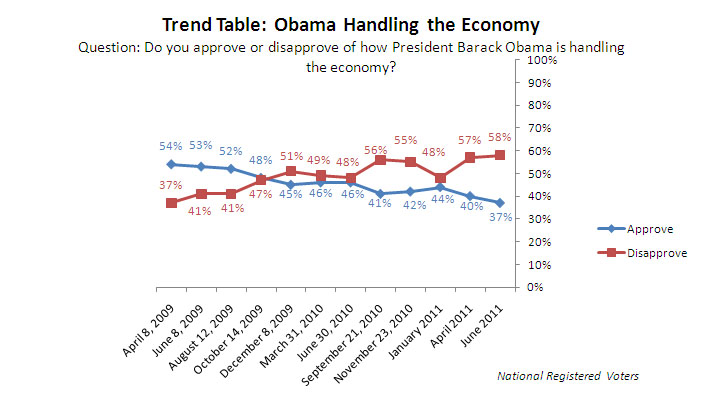
Voters are also voicing their dissatisfaction over the president’s handling of the economy. In fact, President Obama’s rating on the economy has hit an all-time low. Just 37% of registered voters nationally approve of the way the president is handling the economy while nearly six in ten — 58% — disapprove. Five percent are unsure.

When McClatchy-Marist last reported this question in April, 40% gave the president high marks on how he was dealing with the economy while 57% rated his performance as sub-par. Three percent, at the time, were unsure.

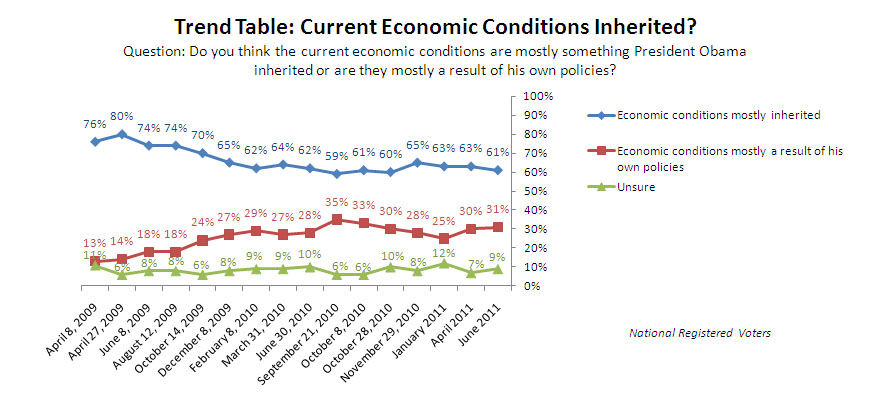
However, many voters still don’t blame President Obama for the nation’s current economic conditions. 61% report the president inherited them while 31% think they are the result of his own policies. Nine percent are unsure. Little has changed on this question since McClatchy-Marist’s previous survey. In April, 63% thought the president faced these trying economic conditions when he entered office while 30% said his policies created them. Seven percent, at the time, were unsure.

The McClatchy-Marist report can be read in its entirety by going here.

Creating Jobs

By Congressman Steve Austria

Currently, the national unemployment stands at more than 9 percent, we have experienced 28 months of unemployment above 8 percent, and Ohio’s unemployment is more than 8 percent. In our own communities we have seen these statistics play out on a daily basis. Most of us know of a family member or friend struggling to find work or may know of a local business that has just shut its doors. Many people have lost their homes and a lot of students coming out of college and graduate programs are unable to find the level of gainful employment they are seeking. To put a difficult issue simply, we are facing tough economic times.

June marks the one-year anniversary of this President declaring a “Summer of Recovery.” In my opinion, last summer seemed like anything but a recovery, and this summer is not looking much different. The truth of the matter is that the last Congress failed to deliver on the promises they made to put Americans back to work. We are now faced with a crippling national debt that threatens the ability to help our country stay competitive in the global marketplace.

To jump start our economy and get Americans back to work, we must go in a different direction than where the previous Congress led us. It is time to get America back to what it does best – which is creating, innovating and leading the world. I am committed to taking every possible step to help get our country back on track and Americans back to work, but I will not do it by putting the tab on our children and grandchildren.

Since January, my Republican colleagues and I have worked furiously to cut spending. These funding debates have not been easy, and tough decisions have been made and are still being made. Our philosophy is based on the tried-and-true economic principle that we must stop borrowing and cut spending which will provide more certainty in the private sector and thus grow the economy.

In order to regain the confidence small business owners and entrepreneurs need to hire new workers and expand, we must remove the Washington red tape and the unnecessary, burdensome regulations. We must streamline the tax code and lower the tax rate for businesses and individuals to spur investment back into the economy and encourage growth. Furthermore, it is important that we promote lower energy costs through increased production, have less reliance on foreign oil, and encourage all forms of domestic energy production.

To learn more about our plan to put the economy back on track, please visit www.jobs.gop.gov.

CSI Ohio Reforming State Regulatory Environment One Rule at a Time

By Lt. Governor Mary Taylor

When Avon Mayor Jim Smith read an article about the launch of CSI Ohio: The Common Sense Initiative in January, he sat down and drafted a letter to me. Smith’s letter detailed a problem that was keeping a local small business from being competitive, growing and possibly adding more jobs in Lorain County.

Custom Culinary, a local food manufacturer, was being bogged down by a senseless government regulation that prohibited it from purchasing bulk quantities of alcohol for the production of soups, sauces and purees. For one recipe, some of the company’s 39 employees had to pour 140,000 pounds of wine into a vat of sauce one bottle at a time. The process was time consuming, costly and kept the business at a competitive disadvantage. It took just three days for CSI Ohio to identify a common sense legislative solution to Custom Culinary’s problem, something Mayor Smith had pleaded with others for years to fix.

Gov. John R. Kasich and I developed CSI Ohio to do exactly what it did for Custom Culinary: solve problems. Since it was launched on January 10th, CSI Ohio has been busy developing a process to hold state government accountable for implementing business regulations that incorporate the principles of transparency, consistency, predictability, flexibility and balance. As agencies develop new regulations and review existing ones, CSI Ohio will require them to analyze the regulation’s impact to business. The questions we are asking include the following: What are you trying to accomplish through the regulation? How will you know if it’s been successful? What types of businesses are impacted and how much will it cost Ohio’s job creators?

The state’s new rule review program is off to a productive start. Agencies are pulling back regulations that don’t meet the common sense test. They are identifying alternative regulations that are just as effective but have less impact on business and job creation. And perhaps most important, they are bringing stakeholders and interested parties into the process of developing regulations, not just commenting after the fact.

For example, in March, the Public Utilities Commission of Ohio rescinded administrative rules that would have applied the same standards meant for cross-country semi-truck drivers to small business owners (such as landscapers, builders and event supply companies) with vehicles between 10,001 and 26,000 pounds. In April, the Ohio Optometry Board withdrew a rule that would have changed the terms of contracts between licensed optometrists and retail stores for providing eye care services. And more recently, CSI Ohio worked with the Ohio Environmental Protection Agency to complete the delivery of a long-awaited package of general permits that had lingered at the agency for the past ten years.

We most certainly have our work cut out for us as we move forward and begin to see tangible results, but we need your help as well. Feel free to contact us via email at CSIOhio@governor.ohio.gov or visit us online at www.governor.ohio.gov/csi to get routine updates and to let us know about senseless government rules or regulations standing in the way of job creation.

Mary Taylor is Ohio’s 65th Lieutenant Governor. She was sworn into office on January 10, 2011, the same day Governor John R. Kasich named her to lead CSI Ohio: The Common Sense Initiative to reform Ohio’s regulatory policies, and serve as the director of the Ohio Department of Insurance.